

Artist Spotlight
Jelly Roll Morton
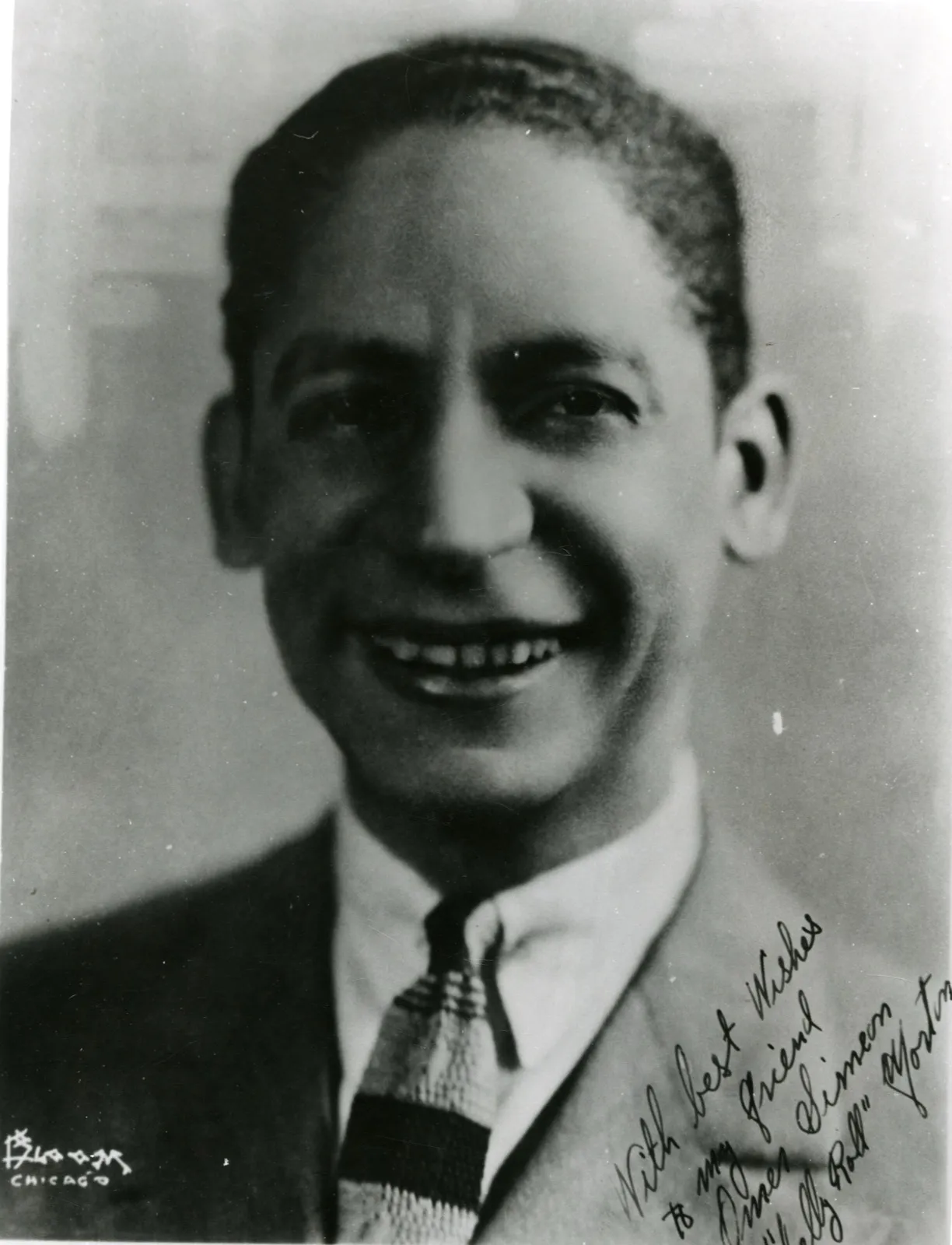

“…He started his upward climb from there, winding up as a respectable innovator and creator of jazz (although he didn’t invent the music as he claimed)”
Ferdinand Joseph LaMothe, more commonly known as “Jelly Roll Morton”, may not have invented jazz, but he was certainly still an important figure to its early development. It could even be argued that he was one of the first “true ambassadors” of jazz music1. This is evident from many aspects of his professional career2, but his innovations to jazz make for an interesting starting point. Morton brought his New Orleans upbringing to the ragtime tradition and most likely preferred performing his own original music3. Gunther Schuller notes that his compositional style was mature by the 1920s, which indicates that he must have developed his ideas much earlier4. Harlem stride pianist, James P. Johnson remembers hearing Morton play “Jelly Roll Blues” in New York in 1911. “The place was on fire!”, Johnson reminisced. In 1912, Morton himself notes that by writing out some music for a local pickup band in St. Louis, he was able to help them play “some pretty fair jazz”5. Morton was a creative force and a credible composer/arranger at a time when a widely understood “jazz idiom” did not yet exist the way it does today. Well before what has been commonly accepted as the first jazz recording in 1917, Jelly Roll Morton was performing and sharing original ideas across the country, which certainly should earn him the title of “ambassador”.
Notes
-
Alyn Shipton, A New History of Jazz (New York: Continuum International Publishing Group, 2007), 71 ↩
-
In addition to having a talent for composing, Morton was also known for having a rather boastful personality to match his fashion style. This helped him stand out as he traveled across the country playing his music. ↩
-
Alyn Shipton, A New History of Jazz (New York: Continuum International Publishing Group, 2007), 69 ↩
-
Gunther Schuller, “Morton, Jelly Roll,” The New Grove Dictionary of Jazz, Barry Kernfeld ed. (London: Macmillan, 1988); “The First Great Composer,” Chapter 4 in Early Jazz: Its Roots and Musical Development (New York, Oxford University Press, 1968). ↩
-
Alyn Shipton, A New History of Jazz (New York: Continuum International Publishing Group, 2007), 69 ↩